 How-to
Smart 2 Bedroom Apartment Storage Solutions That Work
Last Updated: November 24, 2026
Quick Summary
Effective apartment storage starts with a plan: measure every closet, wall, and under-bed gap, declutter before buying anything, and assign one storage job per zone. Then match renter-friendly pieces like tension rods, over-the-door racks, and freestanding shelving to the gaps you actually found, spending on structure and saving on containers.
- Measure closet width and depth, under-bed gaps, door widths, and open wall space before buying.
- A second closet rod can roughly double hanging space for shirts and shorter garments.
- Spend on structure like shelving units and save on basic containers that hold the items.
- Buy secondhand shelving units, bookcases, and storage bed frames first to stretch your budget.
- Standardize container sizes so bins move between closets and under beds as needs change.
Table of Contents
- Why 2 Bedroom Apartment Storage Solutions Start With a Plan
- Measure, Declutter, and Map Your Space Before You Buy
- Vertical Storage Ideas for Apartments: Use the Walls You Already Have
- Storage Ideas for Small Spaces Bedroom: Make the Second Room Earn Its Keep
- Renter-Friendly Apartment Storage Hacks That Skip the Drill
- Apartment Storage Ideas on a Budget: Spend Where It Counts
- Match Your Storage Plan to Your Household and Layout
- Tour a Two-Bedroom at Waters Haven and Test the Storage Yourself
- Frequently Asked Questions
Why 2 Bedroom Apartment Storage Solutions Start With a Plan
Most renters buy bins and shelves before they know what they own. That is why so many 2 bedroom apartment storage solutions fail. The closet ends up full, the floor stays cluttered, and nothing has a real home.
The unit is often fine. The plan is what is usually missing.
Apartment storage is the practice of assigning a fixed place to every item you own, using the space you already rent. It works best when you match storage to your rooms, your household, and your lease terms.
Below, we walk through a plan-first approach, room by room. You will get renter-safe fixes, budget tiers, and a simple way to test any unit before you sign.
Measure, Declutter, and Map Your Space Before You Buy
Start with a tape measure, not a shopping cart. Measure closet width and depth, the gap under each bed, door widths, and open wall space. Write it all down.
Then declutter. A common mistake is buying organizers to hold things you should donate. Sort into keep, donate, and toss piles before you spend a dollar.
Next, map each room. Assign one job per zone: sleeping, working, storing. The U.S. Department of Housing and Urban Development guide to apartment living offers helpful context on what renters can reasonably expect from a unit.
Here is the workflow we recommend:
- Measure every closet, wall, and under-bed gap
- Declutter before you buy anything
- Map one storage job per zone
- Buy only for the gaps you found
- Recheck after one week of real use
Vertical Storage Ideas for Apartments: Use the Walls You Already Have
Walls are the most wasted space in a rental. Vertical storage ideas for apartments put that height to work without touching the floor.
Floating shelves and wall shelves add storage without eating floor space. Tall shelving units and bookcases use height instead of width. Open shelving keeps everyday items visible and easy to grab.
For renters who cannot drill, tension rods and over-the-door racks do the same job. A tension rod inside a closet doubles hanging space in minutes.
If you want more ways to stretch a small footprint, see our guide on how to make a one-bedroom apartment feel bigger. The same wall tricks apply in a two-bedroom.
Storage Ideas for Small Spaces Bedroom: Make the Second Room Earn Its Keep
The second bedroom is usually the smallest room and the most crowded, so it rewards planning more than any other space in a two-bedroom unit.
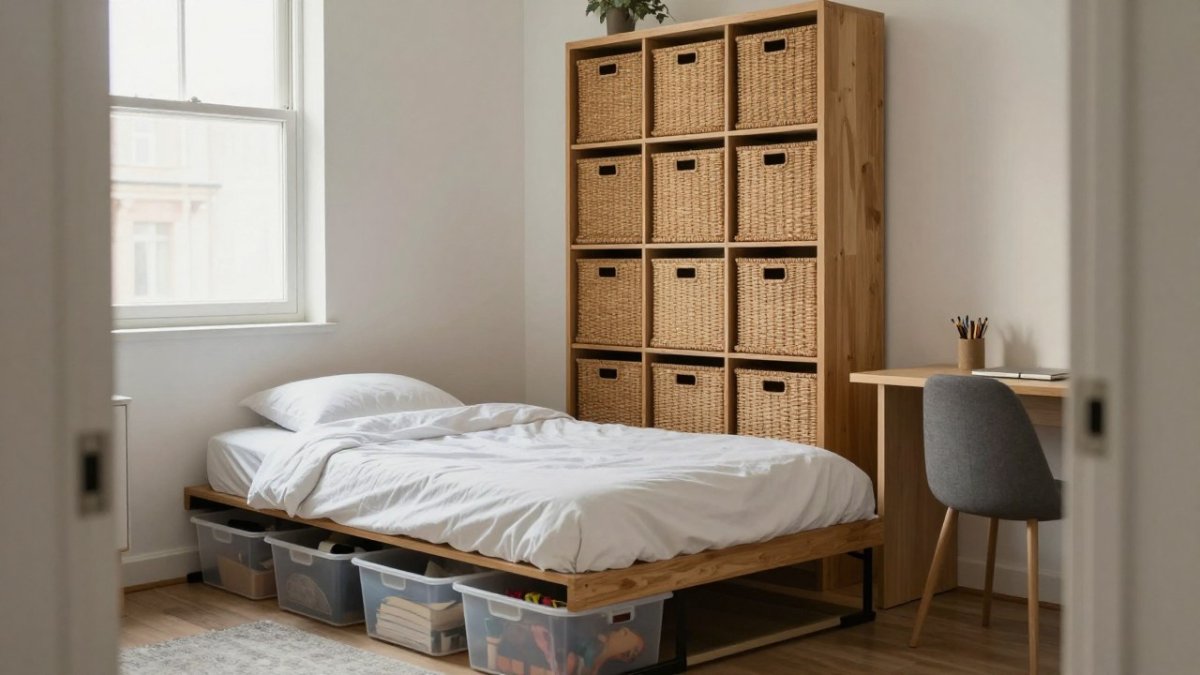
Start by measuring the three zones that carry the load.
Under the bed. A standard bed frame leaves roughly 6 to 8 inches of clearance; a bed on risers or a storage bed frame typically opens 10 to 14 inches. Measure the gap from floor to the bottom of the frame, then subtract an inch so bins slide without scraping. Clear bins in a height range that matches your measured gap work well, and wheeled bins are useful where you pull them out often. Store off-season clothing, extra linens, and bulky items here, not things you need daily.
Up the wall. Measure the open wall from the top of the bed to the ceiling and from the bed to the nearest door or window. A tall bookcase or shelving unit can hold books, baskets, and decor in one footprint.
Inside the closet. Measure width, depth, and the height from floor to the top shelf. A second closet rod can roughly double hanging space for shirts and shorter garments. Stack totes on the top shelf for items you touch twice a year, and use the door for hooks and an over-the-door rack for bags and belts.
Then match the room to the household, because the same square footage needs different storage depending on who uses it.
- Roommates: assign each person one side of the closet and one labeled under-bed bin. Shared shelving holds communal items only, which prevents the second bedroom from becoming a dumping ground.
- Couples: divide hanging space and add a shared shoe rack; a storage bed frame pays for itself when two people share one closet.
- Children: keep bins at kid height, anchor tall bookcases to the wall, and use low open baskets so toys go back without adult help.
- Work-from-home: a desk with drawers plus one closed cabinet for paperwork keeps office clutter out of sight; measure the desk depth against the walkway before buying.
- Pets: reserve one low bin for leashes, food, and toys so pet gear does not spread across the room.
Watch out: a tall bookcase or shelving unit that is not anchored can tip when a bin is pulled from an upper shelf, so secure it to a stud or use a freestanding unit rated for the load.
Renter-Friendly Apartment Storage Hacks That Skip the Drill
Renter-friendly apartment storage hacks avoid nails, screws, and permanent changes. Your security deposit is less likely to be affected, and you can take everything to your next place.
Over-the-door organizers can add storage to a door. Adhesive hooks can hold light items such as keys and bags, and tension rods can be used in closets and under sinks.
Freestanding options do the heavy lifting:
- Rolling carts for kitchen and bath supplies
- Modular storage cubes that stack and reconfigure
- A slim bookcase as a room divider in open layouts
- Stackable baskets for shelves and counters
What most guides miss is weight. Adhesive hooks have limits, so check the label before hanging anything heavy. Watch out: overloaded floating shelves can pull free and damage drywall, which costs you at move-out.
Apartment Storage Ideas on a Budget: Spend Where It Counts
Apartment storage ideas on a budget follow one rule: spend on structure, save on containers. A sturdy shelving unit lasts for years and moves with you; the bins inside it can be basic and replaced as needs change. The trap most guides fall into is treating every organizer as an equal purchase. It is not. Structure carries weight and survives moves, containers hold things, and decor hides the result.
Compare cost per use, not sticker price. Run the math on any piece before you buy: divide the price by the number of years you expect to use it, then by how often you will touch it.
Here is how the tiers break down for a two-bedroom renter, with the trade-offs that matter at each level.
| Budget Tier | What to Buy | Typical Spend | Best For | Trade-Off |
|---|---|---|---|---|
| Low | Baskets, adhesive hooks, tension rods, clear bins | Under $50 total | Quick fixes in closets and under beds | Adhesive hooks have weight limits; tension rods slip on textured surfaces |
| Mid | Rolling cart, stackable bins, over-the-door rack, second closet rod | Roughly $50 to $150 | Bedrooms, closets, kitchen | Rolling carts need floor clearance; over-door racks can mark paint |
| Higher | Freestanding shelving unit, storage bed frame, modular cubes | Roughly $150 to $400 | Long-term, heavy items, shared rooms | Heavier pieces are harder to move and may not fit a future floor plan |
Three renter-specific moves stretch any budget further.
- Buy secondhand structure first. Shelving units, bookcases, and storage bed frames are the pieces worth buying used, because they are the most expensive new and the easiest to inspect for damage. Check joints, hardware, and whether the unit can be disassembled for moving.
- Standardize container sizes. Buying the same bin size across rooms means bins move between closets and under beds as needs change, and you never own an orphan container that fits nowhere.
- Spend on the zone you touch daily. The closet you open every morning and the under-bed gap you use weekly deserve the sturdier piece; seasonal storage on the top shelf can stay basic.
Watch out: check the load rating of any shelving or storage bed frame against what you plan to store, and assemble it according to the manufacturer's instructions.
Match Your Storage Plan to Your Household and Layout
A storage plan should fit the people, not just the square footage. A couple needs different storage than a family or a remote worker.
Roommates need clear zones and labeled bins. Couples sharing one closet need divided hanging space and a shared shoe rack. A home office needs a desk with drawers and closed storage for paperwork.
Your apartment layout matters too. A galley kitchen has different wall space than an open one. Walk your unit and note every awkward space: corners, alcoves, the gap beside the fridge.
First-time renters should weigh which features matter most before signing. Our guide on the best apartment features for first-time renters covers what to look for in a floor plan.
Tour a Two-Bedroom at Waters Haven and Test the Storage Yourself
A floor plan on paper hides the details that decide whether storage works. Tour the unit and open every closet, cabinet, and door.
Bring your tape measure and test the real gaps. Check closet depth, under-bed clearance, and wall space in each room. Ask about the onsite laundry facility and how it fits your routine.
Before your visit, our guide on how to prepare for an apartment tour walks you through what to bring and what to check.
At Waters Haven, our one and two-bedroom floor plans give you room to build a storage plan that lasts. Residents also have access to a pool and an onsite laundry facility. Planning a layout first? Start with these two-bedroom apartment layout ideas before you shop.
Storage problems rarely come from too little space. They come from buying bins before measuring, and from skipping the declutter step. We would start with a tape measure, one room at a time, then add only what fits.
Waters Haven offers one and two-bedroom floor plans, a pool, and an onsite laundry facility in a community-focused setting. Schedule a tour and see how much storage your next apartment really has.
Frequently Asked Questions
How big of a storage unit do I need for a 2 bedroom apartment?
Most two-bedroom households do fine with a 5x10 or 10x10 unit if they only need to store seasonal items, bikes, or extra furniture. A 10x10 unit holds roughly the contents of a one-bedroom apartment, so it covers overflow from a two-bedroom place without paying for space you will not fill. Measure your bulkiest items first, then size up one step to leave room for walking and stacking boxes.
What are some renter-friendly apartment storage hacks that do not damage walls?
Tension rods, over-the-door organizers, adhesive hooks rated for the weight you need, and freestanding shelving units all add storage without drilling. Command-style strips work well for lightweight items like cables and keys but should not hold heavy pots or tools. For anything tall, anchor freestanding bookcases to a stud with a furniture strap, which most leases allow and which keeps the unit safe.
How can I add storage to a small bedroom without taking up floor space?
Go up and under. Wall-mounted or floating shelves above a dresser use space you already walk past, and bed risers with under-bed bins can free several cubic feet in a room that feels cramped. A tall narrow bookcase takes about the footprint of a nightstand but holds far more. Keep the items you use daily at eye level and push seasonal clothes and luggage to the top shelf or under the bed.
How can I organize a small apartment on a budget?
Declutter before you buy anything, then spend first on the categories that cause the most daily friction, like shoes, laundry, and kitchen counter clutter. Clear storage bins, baskets, and a rolling cart can solve many overflow problems. Check whether your apartment already offers onsite laundry or extra closet space, since using what you pay for beats buying duplicate storage.